Bomberman
ボンバーマン1990Bomberman
ボンバーマンHudson's first PC Engine Bomberman, built around five-player battles.
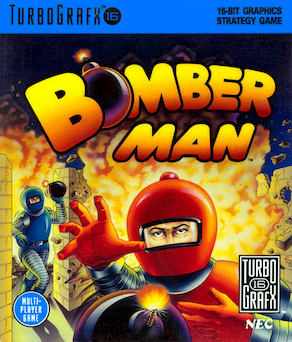
Bomberman is the first Bomberman game on the PC Engine. Hudson Soft made it, and the series had begun earlier on the Famicom. White Bomberman tries to rescue a scientist's daughter from a rogue robot. Its main draw is the five-player battle mode.
| RELEASED IN JAPAN | 7 December 1990 |
|---|---|
| DEVELOPER | Hudson Soft |
| DIRECTOR | Shigeki Fujiwara |
| GAME DESIGN | Tsukasa Kuwahara |
| MUSIC | Jun Chikuma |
| PLAYERS | One to five, with a Multitap for five |
The single-player game runs eight rounds of eight stages each. A boss waits at the end of every round. Each stage is a maze of blocks filled with enemies. You place bombs to clear a path and find the hidden exit.
Each stage hides one power-up under a block, such as extra bombs or a longer blast. The battle mode allows up to five players on a Multitap. Its power-ups are limited to bombs and fire.
A Skull Mode hides skulls under blocks, and they hurt whoever picks them up. The game is also the first in the series with last-man-standing play.
Black Bomberman, a robot built by scientist Dr. Mitsumori, goes bad. He takes Lisa, the scientist's daughter, to a castle. White Bomberman sets out through monster-filled lands to get her back.
Tsukasa Kuwahara was the game's sole designer. The battle mode was first planned for four players. Shinichi Nakamoto, the creator of the Famicom original, suggested expanding it to five.
The character designs were redone for the PC Engine. The balloon enemy Balom returns from the Famicom game.
Reviewers at Computer and Video Games praised the multiplayer. The Amiga conversion, called Dyna Blaster in Europe, became a favourite at computer clubs for its five-player mode.
The 2010 book 1001 Video Games You Must Play Before You Die included the game. The series went on with Bomberman '93 and Bomberman '94 on the same console.
It was the first Bomberman game with five-player battles on the console. The battle mode later became the core of the whole series.
- Power-ups in the battle mode are fewer than in the single-player game.
- The computer opponent did not exist yet, so every battle needed human players.
- Dyna Blaster came out on the Amiga, Atari ST and MS-DOS through Ubi Soft.
NintendoComplete on YouTube